|
|
|
|
 |
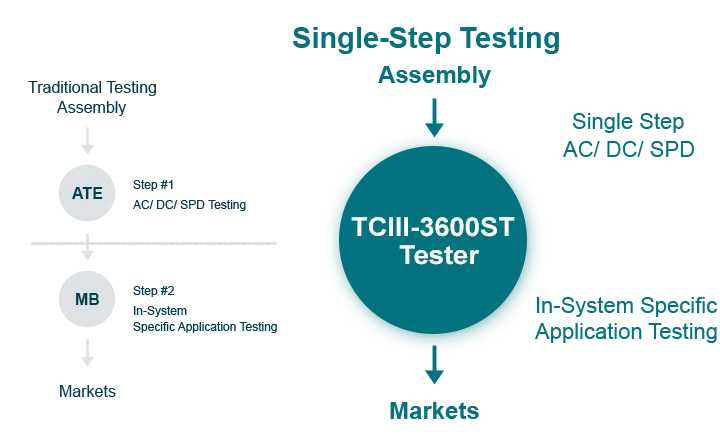
High-end ATE’s are designed to detect functional and AC/DC parametric failures but cannot identify or pinpoint potential in-system failures. Most in-system failures are a result of functional and timing compatibility issues that are generated by the system chipset. Many in-system device failures occur during system boot up or during performance of a specific operation within a given system.
To effectively deal with functional testing as well as in-system compatibility testing, most memory manufacturers incorporate a costly two (2) step testing process as part of their Standard Operating Procedure (S.O.P.)
1. Functional and parametric testing
2. In-System testing utilizing motherboards
One of the most difficult challenges facing memory manufacturers is finding a cost effective method of testing their products so they can minimize time to market and field failures/returns. To facilitate this costly and time consuming process they must incorporate the two (2) step testing process. Capital expenditures, for the equipment and manpower required to do this extensive testing, often result in budget overruns for various cost centers.
To assist manufacturers in their efforts to control costs, Triad Spectrum proudly introduces the new TCIII-1200D multi-site test system. The user selects the target system motherboard and plugs it into the TCIII-1200D. Once the functional testing of the memory is completed, the system automatically switches to begin the motherboard compatibility testing. ONE OPERATOR + ONE SYSTEM=$ saved for the memory manufacturer. Labor costs, equipment costs, field failures, and time to market are all reduced when manufacturers utilize the TCIII-1200D.
Device characterization and failure analysis tools such as Schmoo plotting and address/data error logging are included on the TCIII-1200D to assist engineers in their design/debug processes. An optional hot temperature chamber is available to detect marginal timing and cell storage failures that often occur in high temperature system environments. The chamber is user programmable and can be set at temperatures ranging from 32°C to 85°C with 2°C resolution.
|
|
|
 |
 |
Traditional test systems provide the user with a variety of AC test patterns to use in their testing process. If a customer wanted the capability to generate a proprietary test pattern, they had to purchase a high-end automated test system. For most companies this is cost prohibitive and not a viable option.
|
|

|
Triad Spectrum, Inc. has once again listened to what the customers are saying and is proud to offer a new feature called "Script Code" in its new DDR3/2 test system, the TCII-1200AD. In this new system, the customer can use the script programming language to create a customized test pattern. Once the pattern is created, the "Script Code" pattern generator/ compiler is used to compile the code and then generate the new test pattern.
|
|

|

|
|

|
The "Script Code" function also serves as a powerful compiler/debug tool. It contains a built-in compiler and debugger for the "Script Code" programming which allows the customer to monitor the timing waveform of the programming algorithm as well as the timing bus transactions. This is all accomplished under the "Signal Tap" tool.
|
|

|
The new pattern is then imported into the test list and gives the customer a customized pattern with AC (tSU, tWD, tSAC, tRCD, tCL, tAL, tWR, tRP, tRC, tREF, tRFC, etc.) and DC (Vdd, Vref) parameters for testing their product. In addition to the above, the customer can also create a motherboard test pattern algorithm using the "Script Code" function.
|
|

|
The new TCII-1200AD performs the test pattern much faster than using a traditional motherboard test because there are no wait states in the operating system. Utilizing the "Script Code" function gives the customer a high degree of flexibility in terms of timing bus programming for creating unique Read and Write programmingtransactions under best and worse case AC parameters. This can also be used to create a no-wait state bus transaction in the Read to Write cycle.
|
|

|
|
 |
 |
| 1. |
Script Code Function |
|
Older model Triad Spectrum test systems provided a wide variety of AC test patterns but did not allow the user to generate a proprietary test pattern. The new TCII-1200AD offers the “Script Code” feature. This will let the end user program proprietary test patterns much like the more costly,high end ATE’s. Utilizing the script programming language, the customer can create a customized test pattern and then use the Script Code pattern generation compiler to compile and generate the new test pattern. The new pattern is then imported into the test list with AC (tSU, tWD, tSAC, tRCD, tCL, tAL, tWR,tRP, tRC, tREF, tRFC, etc) and DC (Vdd, Vref) parameters for customized testing.
|
|
| 2. |
Faster Than Motherboard Test |
|
The end user can also create motherboard test pattern algorithms, utilizing the Script Code function and then use this in addition to the programmable AC and DC parameters. Test patterns in the TCII-1200AD perform much faster than the stand alone Motherboard test because there are no "wait states" in the operating systems.
|
|
| 3. |
Enhanced Timing Bus |
|
Script Code programming gives the end user a great deal of flexibility in programming the timing bus to create a unique Read and Write bus transaction under best and worst case AC parameters. In addition, a "no wait" state bus transaction can be created in the Read to Write cycle.
|
|
| 4. |
Powerful Debug/Compiler Tool |
|
A built in compiler and debugger environment is in the Script Code programming. This allows the user to monitor the timing waveform of the programming algorithm and the timing bus transactions under the Signal Tap tool.
|
|

|
|
 |
1. Functional Failure: Cell stuck-at, coupling, neighborhood sensitivity & software error faults.
2. User Script coding lets the user to program proprietary patterns.
3. Parametric Failure: (AC) Speed timing vs. Vdd threshold, (DC) Leakage and Icc's.
4. Hot Temperature Failure: System high temperature environment.
|
|
|
|